Top 5 Casual Games for Quick 5-Minute Breaks
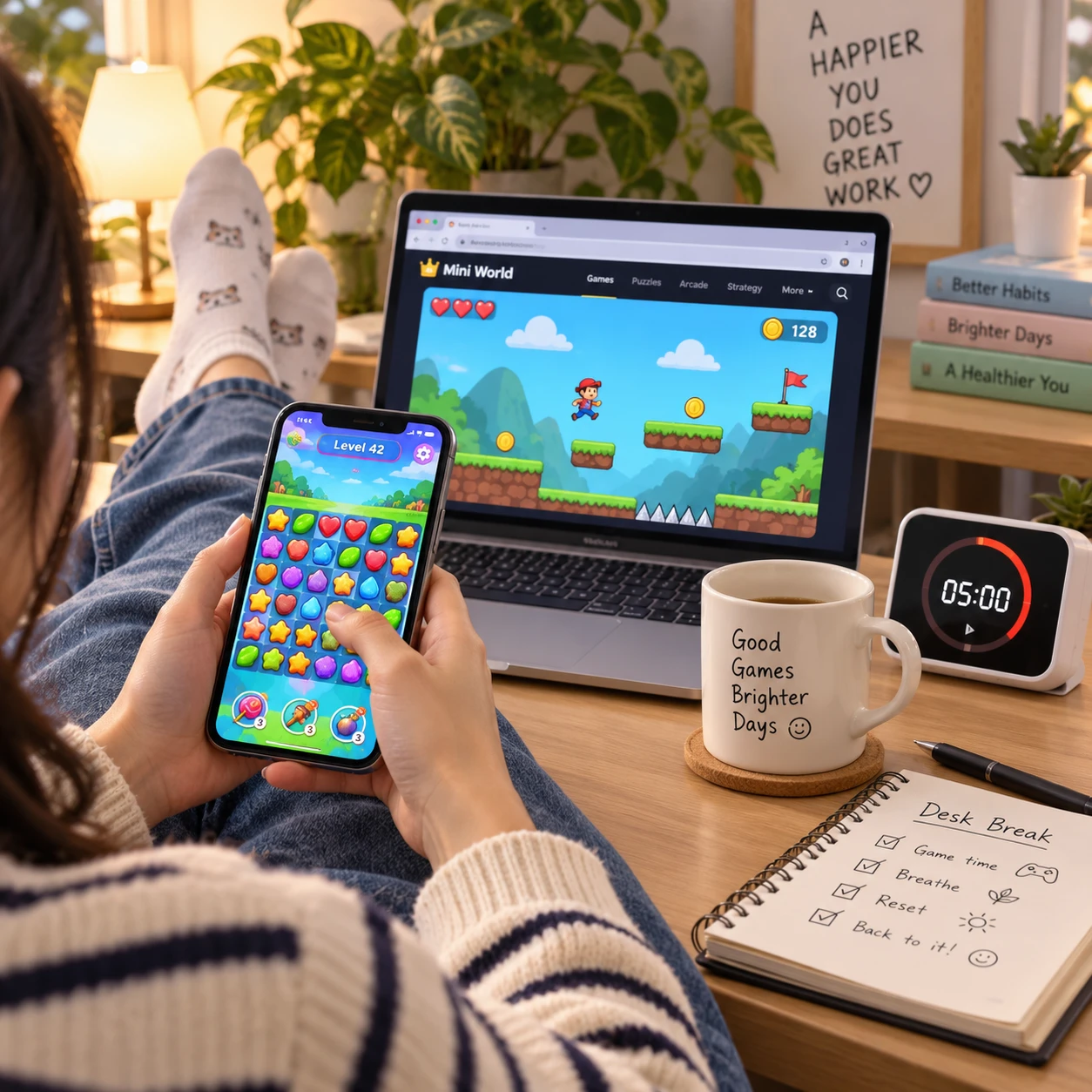
A good five-minute break game gets you into the action quickly and gives you a natural place to stop. The best casual games for short sessions have simple controls, little setup, and rounds or puzzles that feel complete without asking for another half hour.
Here are five distinct styles to try, from match-three and word games to arcade challenges. Specific titles, platforms, and pause options vary, so treat these as game types to look for rather than a promise that every option is available on every device.
What Makes a Game Good for a Five-Minute Break?
A game suits a five-minute break when you can start playing within seconds, understand the goal quickly, and stop at a clear endpoint. Simple controls and short rounds matter more than a large feature list.
Use a quick start-play-stop test before settling on a game:
- Start: Can you reach the first meaningful move without creating an account, installing a large update, or working through a long tutorial?
- Play: Does a round, puzzle, or challenge fit into a few minutes? Clear goals help you stay focused instead of wandering through menus.
- Stop: Can you finish a level, save progress, or pause safely when the break ends?
Pick-up-and-play design is especially useful when you have an unpredictable schedule. A puzzle game with one self-contained board may be easier to leave than a game built around a live match or a long sequence of tasks. Even a short game can stretch past your break if it uses streaks, daily rewards, or repeated prompts to keep you playing, so check how its stopping points work.
The Top 5 Casual Games for Short Sessions
The five most break-friendly casual game styles are match-three puzzles, word games, bite-size logic puzzles, arcade score challenges, and short-run tile or card games. Each offers a different kind of quick satisfaction, with a clear trade-off in pace or stopping flexibility.
1. Match-three puzzle games
Swap adjacent pieces to make rows or groups of matching colors, then use the resulting chain reactions to meet a level goal. The rules are usually quick to learn, and a small board gives you an immediate task. A level can make a tidy five-minute session, though limited moves or an almost-complete objective may tempt you into starting another.
2. Word games
Word searches, anagrams, and short guessing puzzles make a calmer choice. You can usually see the goal at a glance and work at your own pace, which makes word games a good fit if you want a mental reset rather than fast action. The main drawback is that a difficult clue may consume the whole break without a satisfying finish.
3. Bite-size logic puzzles
Number grids, simple path puzzles, and compact brain teasers offer a focused challenge with a defined solution. They are often easy to pause between moves, but difficulty varies widely. Choose a small puzzle or beginner setting if you want a realistic chance of finishing in one sitting.
4. Arcade score challenges
Tap, dodge, or steer through a short arcade round and try to beat your previous score. Arcade games deliver quick energy and work well when you prefer reflexes over reading. Their rounds may last only a few minutes, but replaying for a higher score can make them harder to put down. Choose a mode with a fixed round length if stopping on time matters.
5. Short-run tile or card games
Small solitaire layouts and tile-matching boards can provide a quiet, low-pressure break. You can often make one move, assess the board, and continue when convenient. A full game may run longer than five minutes, so look for quick deals, compact boards, or reliable save-and-resume features rather than assuming every round is brief.
These categories are starting points, not guarantees. A particular title may add timers, long tutorials, or multiplayer features that change how well it fits a short session.
Which Game Fits Your Break?
The right casual game depends on your mood, the kind of challenge you enjoy, and how much attention you can spare. Match the break to the game’s pace and stopping point, rather than choosing by genre alone.
- Want a quiet reset? Try a word game or a small logic puzzle. Both tend to reward concentration without demanding rapid reactions.
- Want color and momentum? A match-three level gives you visible progress, though level goals can encourage one-more-round play.
- Need a burst of energy? Choose an arcade challenge with a short, fixed round. It is lively, but may be less suited to a break that could end at any moment.
- Want flexible stopping? Look for a puzzle or tile game that saves progress between moves. Confirm that the game actually supports this before relying on it.
- Have only a few minutes? Prefer one-screen tasks and avoid modes that require matchmaking, a lengthy tutorial, or a sequence of rounds.
A useful rule is to choose the stopping point first. If you know you must return to a task in five minutes, pick a mode with a timer or a single puzzle, not an open-ended score chase.
Mobile or Browser: Where to Play
Mobile games are convenient when you already have your phone nearby, while browser games can be quick to open on a computer without a dedicated installation. Neither format guarantees a faster start; the game’s loading, sign-in, and save options matter just as much.
On mobile, touch controls suit match-three boards, word searches, and many arcade games. A small screen can make detailed puzzles harder to read, and notifications or battery limits may interrupt a session. Check whether the game needs an internet connection and whether progress saves if you switch apps.
Browser games can be handy during a computer break because they may launch in a tab and use a mouse or keyboard. However, browser compatibility, account requirements, and saved progress differ by title. A game that runs in a browser on one device may not work the same way on another, so avoid assuming it is available everywhere.
For either option, check the basic friction points before your break: loading time, permissions, sign-in prompts, and whether you can pause or resume. A familiar game that opens reliably is often a better five-minute choice than a more elaborate one that needs setup.
Tips for Keeping a Short Gaming Break Short
To keep a gaming break within five minutes, choose a single round or puzzle before you start and stop when that unit ends. A visible timer and a clear endpoint make casual play easier to fit around work or other tasks.
- Set the limit first: Start a five-minute timer before opening the game, especially if it encourages repeat rounds.
- Pick one unit of play: Decide on one level, one puzzle, or one arcade run. Do not make the stopping rule depend on beating a score.
- Check for interruptions: If an incoming call or task could arrive, choose a game with a pause button or progress saving.
- Skip setup-heavy sessions: Avoid downloads, account creation, and tutorials when the break has already started.
- Notice the replay loop: If you often continue after a round ends, choose a calmer game with a natural endpoint.
A common mistake is treating a five-minute break as five minutes of gameplay. Loading screens and menus take time too. Starting with a short, ready-to-play option leaves a little room to close the game and return without rushing.
How to Choose Your Next Quick-Play Game
Choose your next quick-play game by checking three things: how fast it starts, how long one play unit lasts, and how safely you can stop. The best pick is the one that fits your device and break, not necessarily the most popular or feature-rich option.
If you like calm concentration, start with a word or logic puzzle. For colorful progress, try match-three; for a lively burst, choose a short arcade round. Tile and card games suit players who prefer a measured pace, provided the title offers compact sessions or a dependable save feature.
Test a game once with a timer. If you can start quickly, enjoy one complete session, and leave without losing progress, it earns a place in your break-time rotation. If not, try another style. Five minutes is enough for a satisfying reset when the game respects the time you have.
Frequently Asked Questions
What makes a casual game suitable for a five-minute break?
A suitable casual game starts quickly, has simple controls, and offers a short round or clear stopping point. Pause and save options help when your schedule is unpredictable.
Are quick-play games easy to pause?
Some are, but pause behavior varies by title and mode. Single-player puzzles often allow more flexible stopping than live multiplayer matches or timed challenges, so check before starting.
Can I play casual games in a browser?
Many casual games are designed for browser play, but availability and compatibility depend on the specific game and device. Check whether it needs an account, supports your browser, and saves progress.
Which type of casual game is best for a short break?
Word and logic puzzles suit quiet breaks, match-three games offer quick visual progress, and arcade games provide fast action. The best choice is the style with a stopping point that fits your available time.