The Rise of Hyper-Casual Games: Trends and Future Predictions
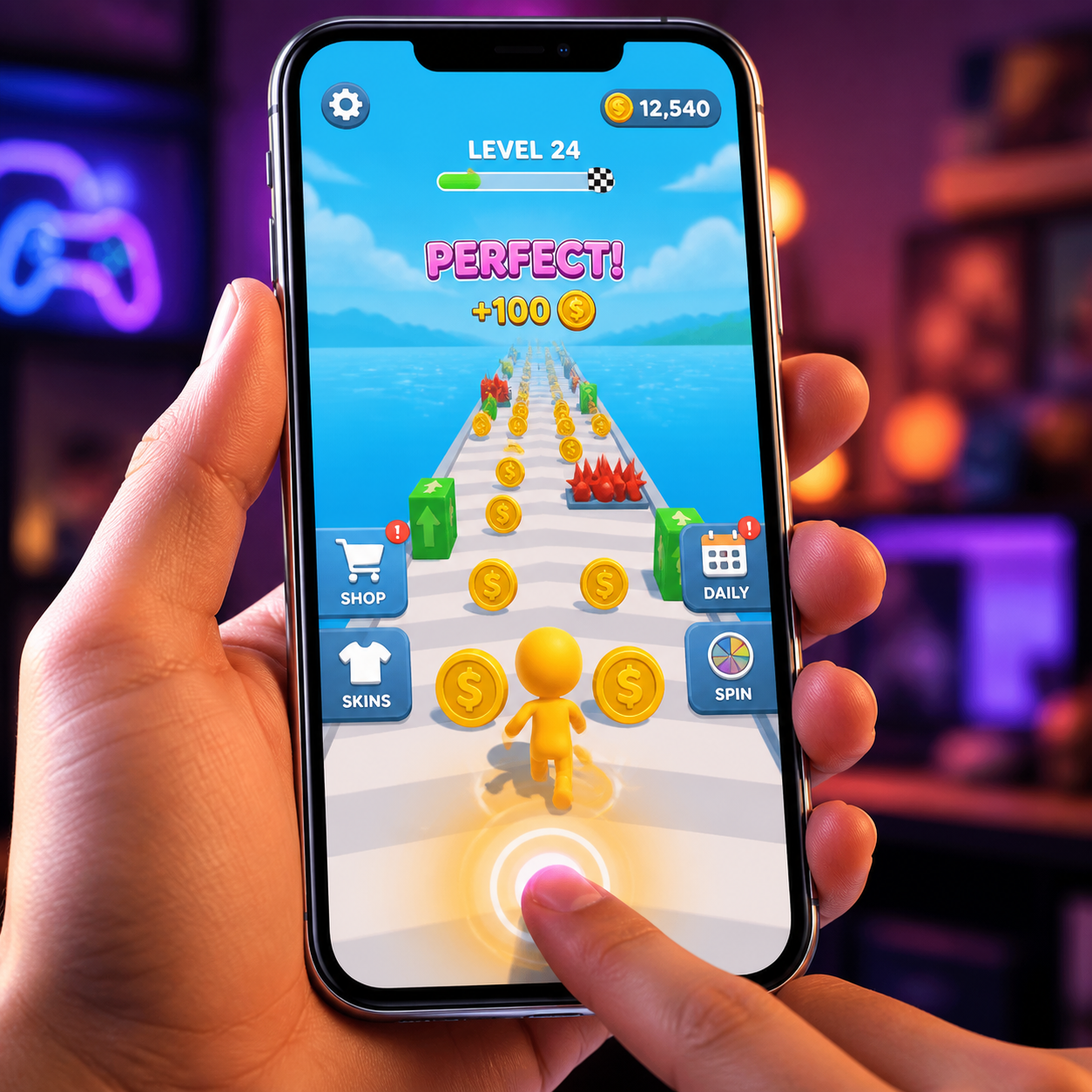
Hyper-casual games changed what players expect from mobile entertainment. Their rules are easy to understand, their controls often require only a tap or swipe, and a complete session may last less than five minutes. That simplicity helped hyper-casual gaming reach people who would never describe themselves as dedicated gamers.
The formula is evolving, though. Developers are adding progression, social systems, personalization, and longer-term goals while trying to preserve the instant accessibility that made the genre successful. The result is a fast-moving space where casual gaming, advertising technology, artificial intelligence, and player creativity increasingly overlap.
What Are Hyper-Casual Games?
Hyper-casual games are mobile games built around simple mechanics, immediate play, and short gameplay sessions. They usually offer one-touch controls or another minimal input system, allowing new players to understand the core challenge within seconds.
A typical hyper-casual game focuses on one repeatable action: timing a jump, stacking objects, avoiding obstacles, sorting colors, or guiding a character through a compact level. The design often removes menus, lengthy tutorials, complex inventories, and detailed narratives. You open the app, play almost immediately, fail or succeed, then try again.
Hyper-casual games sit inside the wider mobile games and casual gaming categories, but the terms are not interchangeable. A casual game may include farming, puzzles, card mechanics, or match-three progression that takes weeks to explore. Hyper-casual design usually prioritizes instant comprehension and low commitment above depth.
That accessibility is a strength, although it can create a narrow design challenge: the game must feel satisfying before its limited mechanic becomes repetitive.
How Hyper-Casual Games Became Popular
Hyper-casual games became popular because they combined mobile-first design, minimal learning curves, and quick rewards with frictionless distribution through app stores and social advertising.
Smartphones created an ideal environment for this format. Players could start a game while waiting for a bus, during a short break, or between other activities. One-touch controls worked well on small screens, and short rounds suited irregular play patterns better than games requiring uninterrupted attention.
The genre also benefited from a strong discovery loop. A player might see a short gameplay clip on a social platform, recognize the mechanic immediately, and download the game to test it. Easy-to-share gameplay made the concept understandable before installation, which helped advertising communicate the product quickly.
Many early titles used ad-supported monetization, including banner advertising, interstitial ads between rounds, and optional rewarded videos. This model reduced the need for an upfront price. Players could try the game for free, while developers earned revenue from a large audience. Some games also offered in-app purchases for ad removal, cosmetic items, or extra attempts.
That model was efficient when players installed games in large numbers. It also exposed a weakness: downloads do not guarantee long-term game retention. If the first few sessions feel repetitive or the advertising interrupts too often, a player may uninstall within a day.
Key Trends Shaping Hyper-Casual Gaming Today
Today’s biggest trend is the move toward hybrid-casual design, which combines hyper-casual accessibility with deeper progression, customization, and social features.
From one mechanic to meaningful progression
Developers increasingly add missions, unlockable characters, upgrade systems, collections, and daily objectives. These features give players a reason to return after the novelty of the main mechanic fades. A short runner, for example, might introduce new environments, equipment choices, and challenge paths without becoming a complicated role-playing game.
The trade-off is clear. More systems can improve retention, but they may also weaken the clean simplicity that defines hyper-casual games. Good design keeps the first action easy while allowing optional depth for players who want it.
Social play, personalization, and live events
Leaderboards, friend challenges, shareable results, and limited-time competitions are becoming more common. Live events can refresh a familiar game by changing the goal or visual theme for a short period. Personalization may adjust difficulty, recommendations, offers, or content based on how a player behaves.
These systems should serve the experience rather than manufacture pressure. A fair weekly challenge can encourage replayability; aggressive notifications and artificial scarcity can make a simple game feel exhausting.
More flexible monetization
Ad-supported monetization remains important, but developers are experimenting with subscriptions, cosmetic purchases, starter bundles, and hybrid models. Rewarded ads are often less disruptive than forced video ads because the player chooses when to watch one in exchange for a benefit.
Players should still examine the balance. A free download may contain frequent interruptions, while a paid ad-removal option may cost more than the game’s actual depth justifies. Monetization is improving in some titles, but it remains one of the clearest dividing lines between a pleasant game and a frustrating one.
The Player Experience: Strengths and Challenges
Hyper-casual games offer exceptional accessibility and convenience, but their short design loops can produce repetition, advertising fatigue, privacy concerns, and unstable retention.
The strongest benefit is low commitment. Players do not need a powerful device, a long tutorial, or a large block of free time. Clear controls also make many games approachable for children, older players, and people with limited gaming experience, although accessibility varies by title.
Replayability comes from trying to beat a personal score, master timing, or reach a new stage. Small improvements can feel rewarding because the feedback is immediate. A well-tuned game makes failure understandable: you know what went wrong and want to attempt the same challenge again.
The main problems appear when the loop lacks variation. Repeating the same action with only cosmetic changes can make a game feel disposable. Excessive advertisements interrupt concentration, and data collection practices may raise privacy questions. Players should review permissions and privacy information rather than assuming every free mobile game handles data in the same way.
Retention is another challenge for developers. A player may enjoy a game for ten minutes but never return. Stronger progression helps, yet forced engagement can backfire. A useful review test is the three-session check: does the game remain enjoyable after the first impression, after several rounds, and when the initial unlocks run out?
Technology and Design Innovations
Artificial intelligence in game development, procedural content, advanced analytics, cloud gaming, and user-generated content could give hyper-casual games more variety without sacrificing quick access.
AI tools can help developers prototype mechanics, generate art variations, test difficulty curves, and identify where players stop playing. They do not remove the need for human design judgment. Automated content can become visually inconsistent, predictable, or difficult to evaluate if teams prioritize speed over quality.
Procedural generation may create fresh obstacle layouts, puzzles, or level combinations. This is especially useful for a genre built around repetition. The limitation is fairness: randomly produced content must still be readable, beatable, and appropriate for the player’s skill level.
Improved analytics can show whether a player quits because of difficulty, an intrusive ad, confusing controls, or a slow loading screen. Used responsibly, that information supports better design. Used carelessly, it can encourage endless optimization for clicks and short-term revenue instead of enjoyment.
Cloud gaming may eventually make more ambitious casual experiences available across phones, browsers, tablets, and connected televisions. User-generated content could have an even more direct effect. Players might build obstacle courses, decorate spaces, or share challenges, giving a simple game a constantly changing supply of ideas. Moderation, copyright protection, safety tools, and server costs will determine how practical these systems become.
Future Predictions for Hyper-Casual Games
The future of hyper-casual games will probably feature deeper optional systems, cross-platform play, more balanced monetization, and continued experimentation rather than one fixed formula.
First, the boundary between hyper-casual and hybrid-casual games will continue to blur. The opening minute will remain simple, but successful titles may offer richer maps, collections, competitive modes, or player-created levels over time. This approach gives developers more opportunities to build retention without placing complexity in front of beginners.
Second, cross-platform experiences may become more common. A player could begin a short session on a phone, continue in a browser, and compete with friends on another device. Such integration will depend on account systems, performance consistency, and fair control design.
Third, monetization may become more transparent. Rewarded advertising, cosmetic purchases, and reasonably priced ad-free options can coexist when the player understands the exchange. This does not mean every game will adopt a friendly model, but player trust is likely to matter more as app stores become crowded.
Finally, AI-assisted creation and user-generated content may expand the range of available experiences. Some experiments will fail; rapid production can produce a great deal of sameness. The games that stand out will still need a memorable mechanic, responsive controls, and a reason to return.
How to Choose Enjoyable Hyper-Casual Games
To choose an enjoyable hyper-casual game, test its controls, observe its advertising, inspect progression, and check whether independent reviews describe genuine variety beyond the first few minutes.
- Controls: The main action should respond quickly and consistently. Delayed taps or imprecise swipes make even a good idea feel unfair.
- Ad frequency: Notice whether ads appear after every attempt, only at natural breaks, or mainly as optional rewards. Frequent forced interruptions are a warning sign.
- Progression: Look for meaningful unlocks, new challenges, or changing objectives rather than endless cosmetic repetition.
- Originality: Familiar mechanics are fine, but the game should add a distinctive visual idea, rule, level structure, or sense of humor.
- Accessibility: Adjustable sound, readable text, color clarity, vibration controls, and left-handed options can make a significant difference.
- Review signals: Read comments about play after the first hour, battery use, loading, privacy permissions, and ad behavior. Ratings alone rarely reveal the full experience.
A practical rule is to judge a game by the value of its interruptions. If an advertisement arrives at a natural pause and provides a useful choice, the model may feel acceptable. If it repeatedly breaks a challenge without adding value, the game is probably optimizing revenue at the expense of play.
Frequently Asked Questions
What is a hyper-casual game?
A hyper-casual game is a simple mobile game with immediate controls, short sessions, and a mechanic that players can understand quickly. Many use tapping, swiping, timing, or dragging as their primary input.
How are hyper-casual games different from casual games?
Hyper-casual games usually minimize learning time and focus on a compact gameplay loop. Casual games can also be accessible, but they often include more complex progression, stories, puzzles, economies, or long-term goals.
How do hyper-casual games make money?
Most rely on advertising, especially interstitial and rewarded video ads. Some also use in-app purchases for cosmetics, extra attempts, upgrades, subscriptions, or ad removal.
Are hyper-casual games likely to remain popular?
They are likely to remain popular because mobile players value convenience and quick entertainment. Individual formulas may fade, but the underlying demand for accessible short-session games is unlikely to disappear.
What trends will shape the future of hyper-casual gaming?
Hybrid-casual progression, personalization, social competition, user-generated content, artificial intelligence, cross-platform play, and more careful monetization are likely to shape the genre. Their success will depend on whether they add variety without making games harder to enter.